Custom Search

Friday, January 25, 2008

The Fielding Positions

There are only 11 players in the fielding side including one wicket keeper and a bowler. So there are, at a time, only nine fielders on the field and the captain of the fielding side has to stipulate various positions to the fielders. A captain cannot do so when the ball is in play or the bowler is about to ball and is in his delivery stride.

Fielding positions
There are only a few basic fielding positions in a cricket ground. Many positions are applied frequently but some are applied only rarely depending upon the situation. Terms like backward, forward and square can further indicate the angle.

Wicketkeeper
It is regarded as one of the specialised positions in the field. A wicketkeeper is also one of the busy players on the field. He gets the ball every now and then when it is a wide ball or batsman misses it in any aspect. A wicket keeper would stand just behind the stumps in case of a spin or a slow bowler. But he would go further behind the stumps in case of a fast bowler.

Slips
The slips is the position where the ball travels very quickly. This is also a catching position as the batsman edges the ball that goes straight into the hands of slip fielders. Nine can be the maximum number of fielders a captain can have in the slips.

There can be nine fielders in the slip cordon. The slips start from exactly one foot behind from the wicketkeeper. The players standing here have good hand and eye co-ordination since the ball travels at a rapid pace and the fielders need to stop it.


There also are positions that are called floating slip and fly slip. A floating slip is the one where the fielder is moved anywhere on the slip cordon. A fly slip is the one that is exactly behind the slips cordon.

Gully
Gully is another one of the catching positions that is just behind square of the wicket on the off side. In this position a batsman would hit the ball while trying to hit the ball over the fielder and will in the process get out. This is also a position where the ball travels quickly.

Point
This position is further away from the gully and is square of the wicket on the off side. The most powerful shots are stopped on this position like the square cut. The best fielders in the business are usually on this position. India’s Yuvraj singh and South Africa’s Jonty Rhodes are the two examples associated with this position.

This area also has a few different positions like:-
1) Backward point
Backward point is behind square of the wicket.

2) Silly point
Silly point is closest to the wicket. It is used when a bowler is bowling spin that might create catching opportunities. They are often seen jumping around when the batsman drives a powerful shot.

Cover
It is the area that covers the point and the mid off. Cover is another important offside position.
At cover there are a few positions where a fielder usually stands.

1) Extra cover
The fielder at extra cover is between the regular cover fielder and mid off.

2) Short Extra Cover
If a fielder gets more close to the wicket in the same angle to the batsman he is said to be at short extra cover.


3) Deep extra cover
Deep extra cover is down the boundary and it is one of the most defensive positions.

Third Man
Third man is the fielder at the boundary on the off side. He is generally deployed there to stop the runs which slips and gully fielders were not able to stop. He is usually 45 degrees to the wicket defending at the boundary. There is usually no third man in a Test match because in that situation the captain employs an attacking field.

Fine Leg
Fine Leg is just the mirror image of third man. It is a place where a bowler can take some rest. It is 45 degrees on the leg side. Though it is not a glamorous position on the field but it is an important run saving position.

Square Leg
Square leg is the position next to where second umpire stands. It is the mirror image of point. And it is also one of the catching positions on the leg side.

At square leg there are a few positions where a fielder usually stands:

1) Deep square leg
This position is at the boundary which is just behind the square leg position. It can be at the angle 0 degrees from the wicket.

2)Short leg
This position is usually for the youngest member in the team. The fielder has to stand close to the batsman wearing a helmet and shinguards. So in a way the fielder is directly in the line of fire on the leg side. The fielder has to be very sharp and

3)Backward square
Backward square is the position where a fielder would be standing on the leg side and would be slightly behind the line of the wicket.

All possible field positions in a cricket filed are shown below


Fielding Positions

Thursday, January 24, 2008

Pictures of Adelaide Test - Day 1


Adam Gilchrist, who dropped VVS Laxman on 37, finally held on to one towards the end of the day.

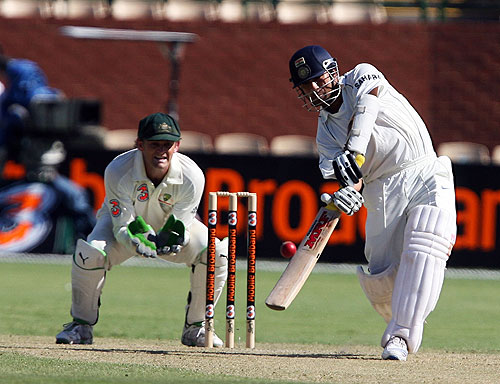
Sachin Tendulkar launched a stunning attack on the spinners.

VVS Laxman acknowledges the crowd after his fifty.

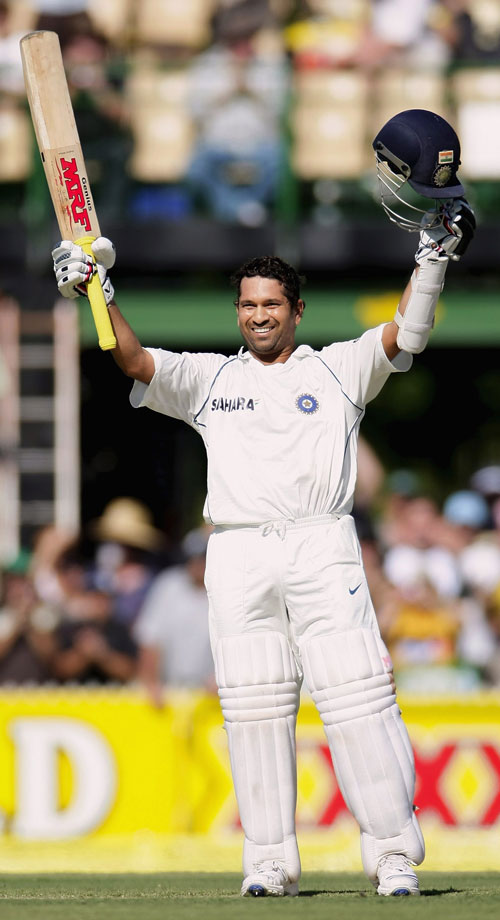
VVS Laxman, who added 126 with Sachin Tendulkar, congratulates him on his hundred.

Sachin Tendulkar reached a quite brilliant 39th Test hundred.

VVS Laxman's assured presence helped India rebuild.

Sourav Ganguly isn't convinced about his leg before decision.

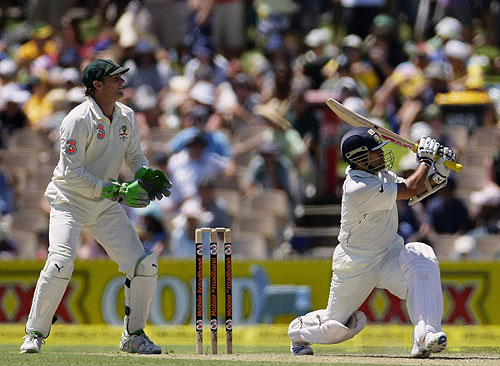
Sachin Tendulkar slogs Brad Hogg over midwicket.

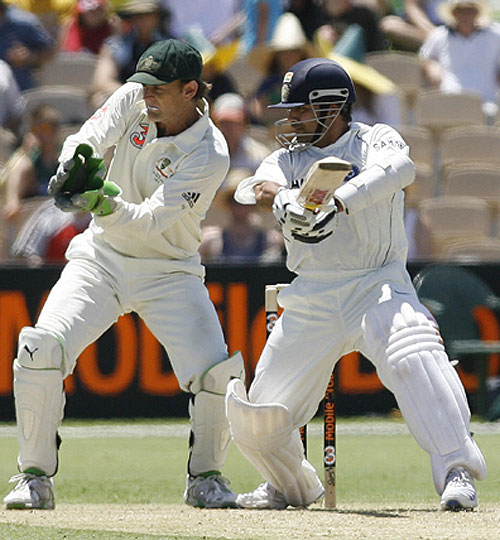
Sachin Tendulkar cuts Brad Hogg for four.

Brett Lee made Virender Sehwag his 20th victim of the series.

Rahul Dravid looked good briefly before getting stuck in a rut.

Mitchell Johnson nails Irfan Pathan for 9.

Virender Sehwag raised his fifty from just 68 balls.

Mitchell Johnson celebrates the wicket of Irfan Pathan.

The Cricket Ball

Weight
For professional men’s cricket, a ball should weigh between 5 1/2 ounces/155.9g to 5 3/4 ounces/163g. The circumference should be between 8 13/16 inches/22.4cm to 9 inches/22.9cm.

For women’s cricket the weight of the ball should be from 4 15/16 ounces/140g to 5 5/16 ounces /151g. The cricket ball should measure from 8 1/4 inches/21.0cm to 8 7/8 inches/22.5cm in circumference. This means that the ball used is slightly smaller in size than men’s cricket.

For youth cricket the ball should weigh from 4 11/16 ounces/133g to 5 1/16 ounces/144g and should measure from 8 1/16 inches/20.5cm to 8 11/16 inches/22.0cm in circumference.

Make up
The cricket ball is made of two halves of cork. The cork is binded by a thick wound of strings. A layer of leather then covers the cork. The layer is divided into four quartered peels of leather, which covers the round ball from all the sides. One hemisphere covers the ball in a 90-degree angle in respect to the other. This cover is then sewn to form a seam that is tied at the equator of the ball. There are in all six rows of stitches. The remaining two joins between the leather pieces are left unstitched.

Red and white
There are two types of cricket balls. One, which is dyed red and the other one is white. The red cricket ball is used in Test as well as first class cricket, whereas the white cricket ball is used in the one-day format of the game. The red ball is also referred to as ‘cherry’.

But there has been a debate over whether both red and white cricket balls are the same when it comes to bowling?

The answer to this may be no. Many veteran players believe that the white cricket ball has more swing and impact than the red ball. Both the balls are made in the same manner as the first ball was made in the 1700s. The balls are made up of the same cork and then leather is put on. But there is just a slight difference between both the balls. The white ball has a harder-wearing coating to stop them getting dirty.

But the manufacturers deny these claims. They say that there is no difference between the two balls and proper remedies are taken to see that the characteristics of the ball remain the same.

The other colours
After the white ball was finalised for limited-over matches, other colours like orange and yellow were also tried and tested. But white proved to be more effective under the floodlights.

Besides the leather ball, there are other balls that are used to play cricket. The local Pakistani bowlers used the ‘taped ball’. In this case a tennis ball is wrapped with electrical insulation tape to harness some hardness in the ball while retaining the softness.

The Laws
The balls that are chosen by umpires and the captains of both the teams will remain in umpires’ possession before the toss and will be under umpire’s control throughout the match.

The umpire will have the ball in his possession after a fall of a wicket, or at the time of drinks break or during the interruption of the play under any circumstances.

Either captain has the right to demand a new ball at the start of an innings. In Test cricket the red cherry can only be changed after the prescribed minimum (80) overs. Other than this the ball can be changed only under a few circumstances-

If the ball has become unfit to play
During a match the umpires can consider the ball as unfit for play because of normal wear and tear. The ball would then be replaced with another one that has had similar wear. This replacement would be informed to the batsmen and the fielding captain.

If the ball is lost
If during play the ball is lost and is not recovered, it will be replaced with another one which is similar in condition to the one lost.

Ball tampering
The condition of the ball is very crucial in the game of cricket. And any infringement to the ball can vary the results of the game by huge margins. So to avoid these defections, ICC has formulated certain laws. These laws are: A player cannot rub any substance apart from sweat and saliva on the ball. These two substances are used only under the pretext of them bieng natural substances. A player is not allowed to rub the ball on the ground under any circumstances. The umpires may however, wipe the ball with a piece of cloth in exceptional cases of ball getting wet and slippery due to dew or any other reason. A player cannot scratch the surface of the ball with any rough object.

LAW 42.3c of ICC rule book states that it is unfair for anyone to rub the ball on the ground for any reason, interfere with any of the seams or the surface of the ball, use any implement, or take any other action whatsoever which is likely to alter the condition of the ball.

The Manufacturers
Sanspareils Greenlands (SG)

In India, Sanspareils Greenlands (SG) are the main manufacturers of cricket balls. They came to India at the time of partition and made their way into Meerut. And since then Sanspareils Greenlands is the brand name that identifies cricket in India.

Even in this age of technology, the ball is made in the traditional way. In India, it takes almost 75 days to make a ball that lasts for a day in Test cricket.

The core of the cricket ball is a cork-rubber and is grey brown in colour. Cork-rubber is then covered with flat strips of cork. Then a wet wool string is wrapped around the cork mixture tightly and more and more layers are wrapped around the core. A wooden bowl is then used to put the core in it, which is moulded into a sphere though a hammer. The mass of cork is then hung on the wall for drying and establishing bounce.

The leather after being checked for its quality is dyed and then cut into oval but pointy-ended parts on a wooden board. Then these oval shaped parts are joined with needles through the borders thereby creating a half ball.

This half ball is then battered in thappai- a machine shaped like a head-clamp instrument to give definite shape. The remaining part of the ball is then covered with steel cups and leather slices and sewn.

But this form of making cricket balls is dying with time. The technological advances of other manufacturers around the world are threatening to conquer this hand made miracle. The latest being BCCI opting for Kookaburra balls for Tests.

Kookaburra Sport
Kookaburra is the most famous manufacturer of cricket equipments in the world. The company was instituted in Australia and established itself in almost all the Test playing nations which also include India and Pakistan.

The history of Kookaburra goes back to 1890s when a migrant, harness and saddle maker, Alfred Grace Thompson turned into making cricket balls. His next generations then helped Kookaburra establish worldwide which now specialises in other equipments of cricket and also hockey.

Ball gauge
A ball gauge is used by umpires to measure the size of the ball. Through ball gauge, the umpires see whether optimum measurements mandated by the governing body are followed or not.

The ball gauge looks like handcuffs. There are two rings connected to each other, one has a diameter through which the ball should not pass. The other is the maximum acceptable diameter through which the ball should pass.

If the ball does not pass through the maximum diameter and passes through the minimum diameter, the ball is deemed to have lost its perfect shape. Umpires should then replace the ball with an old ball that has been used in the comparable number of overs earlier.

( courtesy the ICC)

The Cricket Bat

A cricket bat is very much like a paddle, though uptill the 18th century it used to look like the present day hockey stick. Like the paddle, a cricket bat has a paddled handle. But the cricket bat is sturdier than the handle of the paddle.

The handle of the bat finishes at the shoulder. The shoulder exceeds till the blade which is a flat wooden block on one side and V-shape ridge on the other side to boost the strength of the bat. The bottom of the blade is known as the toe of the bat.

Rules
The Marylebone Cricket Club (MCC) states underlying laws for a cricket bat in the rule book:-

1. Width and length
The bat overall shall not be more than 38 inches/96.5cm in length. The blade of the bat shall be made solely of wood and shall not exceed 4 1/4 inches/10.8cm at the widest part.

2. Covering the blade
The blade may be covered with material for protection, strengthening or repair. Such material shall not exceed 1/16 inches/1.56mm in thickness, and shall not be likely to cause unacceptable damage to the ball.

3. Hand or glove to count as part of bat
In these Laws, (a) reference to the bat shall imply that the bat is held by the batsman. (b) contact between the ball and either (i) the striker`s bat itself or (ii) the striker`s hand holding the bat or (iii) any part of a glove worn on the striker`s hand holding the bat shall be regarded as the ball striking or touching the bat, or being struck by the bat.

The make-up
The bat is made from a willow wood. The willow wood is hard enough to be shock resistant. And is very much a matierial for a cricket bat as through the cricket bat the player has to hit the the ball hard, without denting the surface of the bat. The willow also keeps in check the wieght of the bat, which should be light and the bat should be easy to handle.

A cricket bat is not supposed to be used immediately after its production. It requires knocking which compresses the exposed wood.

The knocking-in
The knocking-in process is very unique and it starts from the edges of the blade as the cracks start appearing on the edges of the bat.

The knocking in process is initiated by applying a thin layer of linseed oil on the blade of the bat. The bat is knocked by a worn down soft leather cricket ball or a tack hammer. The face of the blade is then repeatedly hit for several hours.

After a few hours of knocking-in, another thin layer of linseed oil is applied. The bat is now ready, but only for light practice. For competitive matches some more hours of knocking-in is done. During this stage though, care is taken to protect the spring of the bat from jarring.

This process is the traditional way of making the bat steady for use. However, manufacturers of the bat now a days use machines to compress the bat.

The imperfections
After the bat is made, there could be many imperfections in the bat. These imperfections are as follows:-

Small knot or "Pin knot" is the most common imperfection found in the bat after it is made. These knots are generally up to 10 mm in diameter and at times visible on the face of the bat.

"Speck" is another imperfection which is due to the growing conditions of the tree. In this case, the tree grows in earth containing a lot of gravel or stones. As a result of which there is an uptake of tiny molecules with water that gets deposited. Speck is purely cosmetic and is also a sign of a strong bat.

The third imperfection is the "Butterfly Stain", it is called so as it resembles the body and wings of a butterfly. This imperfection is mainly due to the tree being a hybrid of English Cricket Bat Willow. This makes the bat very strong.

"False Growth" is a common imperfection in the bat. This is caused when the tree stops growing for some reason atleast for a season. The causes can range from drought, fire or weed killer. Nine times out of ten there is no weakness in the bat and they will certianly not break along the False Growth.

Another imperfection is the "dead knot". The tree has been trimmed up very late and the resulting branch has been left to grow for many years. Before this can be used to make a bat the knot is drilled out and filled. As long as it is not on the face of the bat it will have very little detrimental effect on the playability.

The willows
English Willow
English Willow has a fibrous wood which provides excellent rebound performance when the ball strikes the middle of the bat, English willow bats are used by top and middle order batsmen.

Kashmir Willow
Kashmir Willow is a harder and although it is quite similar to English Willow, it is a little more brittle and therefore less responsive when the ball strikes the middle of the bat. Kashmir Willow bats do however offer excellent value for money and are ideal for lower order batsmen, beginners or club bags.

The controversy
The recent controversy concerning the cricket bat originated in October 2005 when Ricky Ponting was stopped from using the Kookaburra bat.

Reportedly, the Kookaburra bat had a graphite plate on it which enhanced stroke play. This clearly violated rule number 6.1 of MCC which states that the “bat shall be made solely of wood.”
The ‘Kahuna’ bat was thus not brought into the play. Similarly, English player Owais Shah was told not to use the same bat as it also had the graphite plate on it.